Try our cookiesAlza.cz a. s., Company identification number 27082440, use cookies and other data to ensure the proper functioning of the website and, with your consent, also, among other things, to personalize advertising and the content of our websites. By clicking on the “I understand“ button, you agree to the use of cookies and the transfer of data regarding the behavior on the website for displaying targeted advertising on social networks and advertising networks on other websites.
We use 8 categories of cookies on our website:
Technical cookies
These are strictly necessary for the functioning of the website and the features you choose to use. Without them, our website would not work; you wouldn't be able to log in to your user account, for example.
Functionality cookies
These cookies allow us to remember your basic choices and improve the user experience. These include remembering your preferred language or allowing you to stay logged in permanently.
Social media cookies
These cookies allow us to easily link you to your social media profile and, for example, allow you to share products and services with your friends and family.
Content personalisation
These cookies allow us to show you content and ads according to the information we have about you to best meet your needs. This includes what content you have viewed, or on what device you are accessing our website.
Non-personalised advertising
These cookies allow us to show you general ads for products and services.
Personalised advertising
Thanks to these cookies, we and our partners can offer you relevant products and services based on your purchases, your shopping behaviour and your preferences.
Audience metrics
These cookies allow us to optimise our site for your convenience based on how you use it. The aim is to remember or anticipate your choices. This includes, for example, the use of features, their location, or the behaviour on the page.
By giving your consent to the processing of cookies, functionality and analytical cookies will be installed on the device you use to browse the website (click on the "I understand" button for both categories, or you can select only one of the categories by clicking on the "Settings" button). We always install technical cookies on your device, even without your explicit consent, because without them our website would simply not work.
You can revoke your consent to the processing of cookies. In connection with our company's cookie processing, you also have the following rights: the right to access cookies, delete, modify, supplement and correct them, restrict processing and the right to lodge a complaint with the Office for Personal Data Protection. Read more about your rights.
The New EU Duty: The End of Cheap Shopping from China
Updated
Cheap parcels from China, screen protectors for a couple of euros, cables with free shipping, or household bits and pieces for the price of a single coffee. For many customers, shopping on Asian marketplaces used to be a regular routine. Until recently, they had one big advantage – a price that was worth it despite the longer wait for delivery. From 1 July 2026, however, this maths no longer adds up. The European Union is introducing a new customs duty on shipments from China and other non-EU countries, affecting even the smallest orders. What exactly is changing, how much more you will now pay, and why it pays to look elsewhere – find out in our article.
i
From 1 July 2026, shipments from China and other non-EU countries with a value of up to €150 will be subject to a fixed customs duty of €3 per tariff item of goods.
The End of Ultra-Cheap Goods from Asia. Is Shopping from China Still Worth It? – CONTENTS
Until now, a simple rule applied: if the value of a shipment from abroad did not exceed €150, no customs duty was payable and at most you had to deal with VAT. It was precisely thanks to this that ordering small items from Temu, Shein or AliExpress was worthwhile. A parcel costing a few dozen euros with free shipping was a completely common thing. That era is now definitively coming to an end.
From 1 July 2026, the European Union is abolishing the existing exemption and introducing a flat-rate customs duty of €3 on each tariff item in a shipment. For small items costing €1 to €2, this flat fee can make up the majority of the final price. On top of the duty itself, 20% VAT is always added, calculated on the customs value of the goods including the duty.
i
The new duty applies to shipments dispatched after 1 July 2026. It therefore does not matter when you placed your order. If you have the goods sent earlier, you will avoid it – however, the actual dispatch from the warehouse is usually beyond your control.
Cheap goods from China are no longer worth it.
According to the European Commission, the main reason for introducing the new duty is the enormous increase in the number of small shipments from Asia. Over four billion of them arrive in the EU every year, the vast majority coming from China. The aim is to level the playing field for European retailers and to limit imports of goods that often fail to meet European safety and environmental standards.
A model example: Why the maths of shopping from Asia no longer adds up
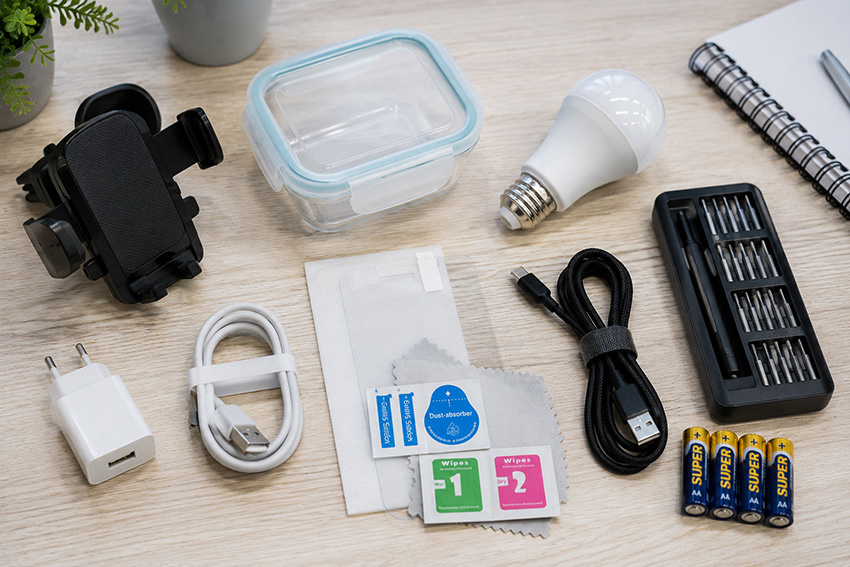
To get an idea of how a purchase will actually change, a simple example is enough. Let's say you want to order a protective glass for your phone, a kitchen storage container and a car organiser – three different items from different categories costing around €8 in total.
Until 30 June 2026, you would only pay the price of the goods themselves and shipping for such a purchase, plus possibly a small amount of VAT. From 1 July, however, a duty of €3 will be added to the price of each item, plus 20% VAT on this increased value. For three different categories of goods, the additional fee can thus easily climb to around €10, i.e. roughly as much as the purchase itself cost. A parcel that used to delight you with its low price suddenly becomes an order that hurts your wallet instead — and on top of that, you still have to deal with customs proceedings.
Comparison table: is the purchase still worth it?
The following table shows how, after the introduction of the new duty, the price advantage of buying from Asian marketplaces changes compared with buying from a Slovak e-shop.
*The prices shown are model figures for guidance only. They are based on average market prices in May 2026 and the calculation of the new flat-rate duty under the approved EU regulation. ** Average prices in the given categories are based on the cheapest goods in our e-shop as of 16 June 2026.
As you can see, in many categories the price difference between an Asian marketplace and a Slovak e-shop is practically disappearing – and that is before factoring in the risk of complaints, longer delivery times or uncertainty around customs proceedings.
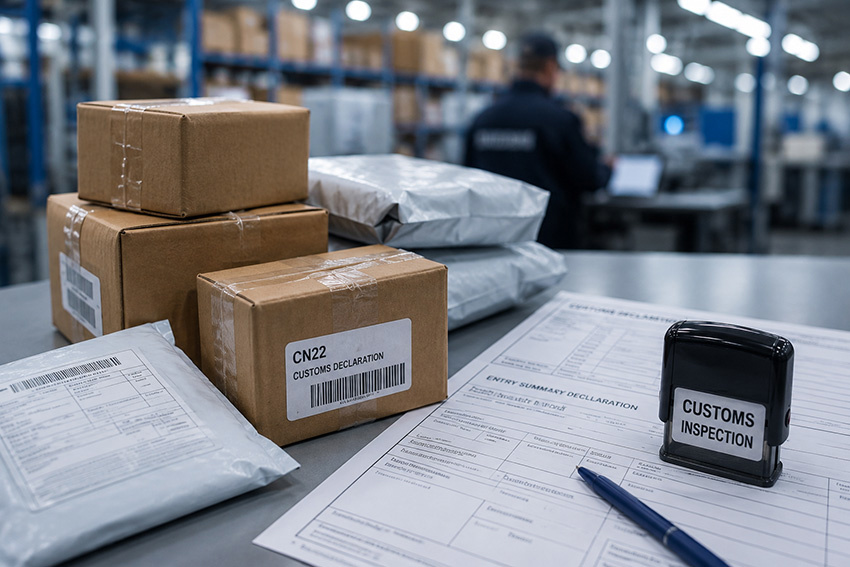
Customs fees will significantly change the prices of cheap goods from abroad.
What hidden risks can cheap purchases from Asia bring?
Price is not the only criterion by which small goods should be judged. With cheap products from unverified sources, there can also be problems with quality, safety and health compliance. This does not mean that every product from an Asian marketplace must automatically be bad. The risk is higher, however, because the customer often does not know who the actual manufacturer is, which standards the product meets, and whether it has been checked for the European market.
Health safety
With kitchen storage containers, organisers, silicone moulds, children's accessories or pet supplies, it matters what material they are made of. Products intended for the European market must meet stricter requirements for health safety, chemical content and safe contact with food. However, many products from Asian marketplaces often do not go through the European REACH regulation, which limits the amount of harmful substances in plastics and other materials. With unverified products, the problem may lie, for example, in the use of low-quality plastics, plasticisers or materials unsuitable for long-term contact with food. For household products, it therefore pays to watch not only the price, but also the origin, certification and intended use of the
product.
Electronics safety
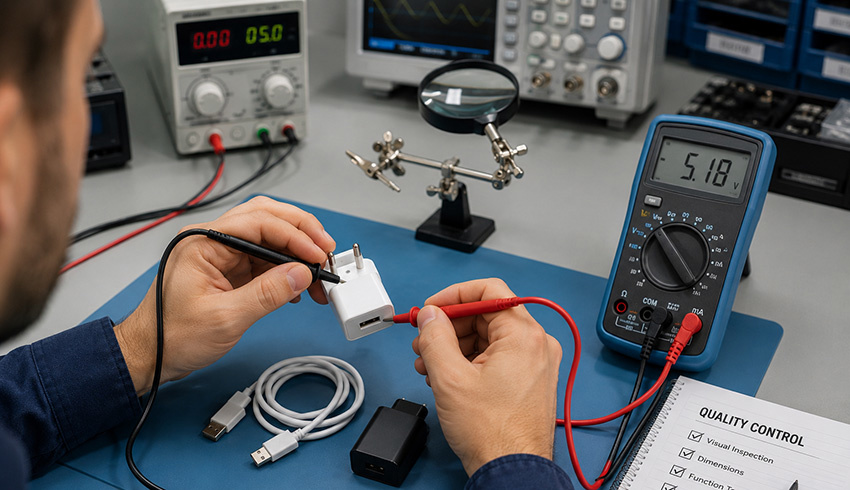
With chargers, USB cables, adapters, LED bulbs or car electronics, a low price can mean compromises in design and protection. A poor-quality cable may not handle the declared current, a cheap adapter may lack reliable overheating protection, and with car accessories, stability in the vehicle's electrical system can also be an issue. In practice, this means a real risk of short circuits, overheating or damage to your phone. The European CE certification is not just a sticker on the packaging – it is a manufacturer's declaration that the product meets the requirements of European legislation. With goods from unverified marketplaces, however, it can be difficult to verify whether the marking is genuine and whether the product has actually undergone the corresponding checks.
Material quality
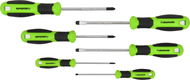
With cheap tools, car holders, organisers or office supplies, the difference often only shows up during use. A screwdriver made of soft alloy can bend or strip a screw. A plastic phone holder can become deformed in a hot car in summer. Cheap office supplies can have a short lifespan and poorer workmanship. A product that looks similar at first glance may therefore not offer the same utility value. If a product only lasts a few uses, the actual cost of ownership may in fact be higher than with a better-quality alternative.
Build quality is essential for the safe use and long lifespan of products.
5 reasons to bet on certainty
With the introduction of the new duty, the difference between buying from Asia and buying from a trusted Slovak e-shop is shrinking noticeably. Here are five reasons why, more than ever before, it pays to shop with us.
Immediate availability: We deliver goods within 24–48 hours, instead of weeks of waiting and hassle with customs clearance.
Guaranteed safety: All products in our e-shop meet European standards and certifications – they are safe for your health and your electronics.
The right to make a mistake: With small goods, it is easy to pick the wrong type of cable, an unsuitable size of protective glass, or a holder that does not fit your car. When shopping with us, you have the statutory right to return goods within 14 days, as well as a full 2-year warranty – without having to send the parcel back to Asia at your own expense.
Great-value multipacks: Our private labels such as AlzaPower, Siguro or AlzaTools offer a low price per piece without you having to pay customs duty on each item separately. The result is a fair price, fast delivery and less to worry about.
Less packaging, less unnecessary waste: Everything arrives in one box, not in ten plastic envelopes arriving gradually over several weeks. It is more practical for you and kinder to the environment.
The goods you find in our e-shop meet legislative standards.
After 1 July 2026, buying small items from Asian marketplaces stops being an automatic win. The customs duty on goods from China and other non-EU countries will make almost every order more expensive, and the higher price comes with the same risks as before – questionable quality, missing certification and complicated complaint procedures. Risking your time, health, electronics and now also your money simply no longer pays off. You can conveniently find quality, affordable alternatives with us.
Glass Screen Protector - for Apple iPhone 16e, iPhone 14, iPhone 13, iPhone 13 Pro and iPhone 17e, 2.5D curved, case friendly design, full cover design, thickness 0,33 mm, glue over the entire surface area, package includes cleaning cloth, alcohol wipe, dust removal sticker, guide sticker and 2 pcs
LED Bulb - lamp cap E14, power input 6 W, luminous flux 750 lm, warm light (2700 K), diameter of 3,5 cm, lifespan 25000 h, energy label E, 2 in package
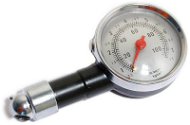
Tyre Pressure Gauge - Professional, all-metal, 0.5 - 7Atm
Buy with codeALZADNI15The discount code gives the option of applying a discount on a given product when entering the code in the shopping cart.
Získajte zľavu 15 % s kódom ALZADNI15. Kliknite a kód sa uplatní automaticky.3.82 €
Glass Screen Protector - for Apple iPhone 17 Pro, iPhone 17 and iPhone 16 Pro, 2.5D curved, thickness 0,33 mm, glue over the entire surface area, package includes cleaning cloth, alcohol wipe, dust removal sticker, guide sticker and 2 pcs