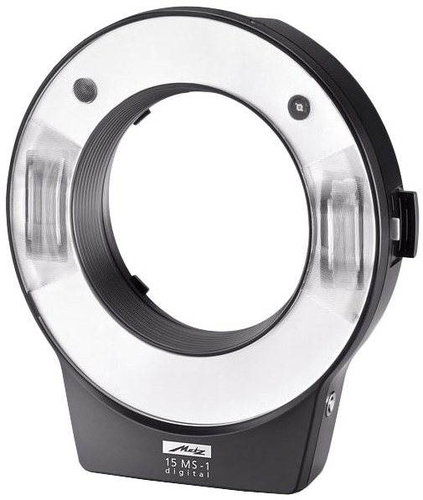
Universal wireless macro with two adjustable reflectors. The flash makes it possible to turn each spotlight between 0º - 20º and to regulate the output of each flash separately - so nothing prevents the scene lighting from actually winning and achieving unexpectedly great results. The advantage is also the easy handling of the flash and its operation, as the flash output is automatically controlled by the wireless slave TTL mode. But there is also a manual setting with which the built-in display aids. The flash also allows you to adjust the power ratio between individual flash lamps. Integrated auxiliary focusing light and modeling light are also available. The flash may also be used provided the camera is not equipped with an internal flash, for which case the Metz 26 MS-1 is equipped with a synchronization connector.
Together with the flash, the reduction rings are available for 52, 55 and 58 mm diameter lenses (the other can be optionally purchased), IR filter holder, case and bounce diffuser.
Parameters and Specifications:
Compatibility: Universal (Canon, Nikon, Olympus, Panasonic, Pentax, Samsung and Sony-Alpha)
Reference number: 15 (ISO 100)
Synchronization: First or second lamella
Charging time: 0.3 and 0.5 s depending on used batteries
The directional number (GN) is a key indicator of external flash performance. It expresses the maximum flash range in meters at ISO 100 and full power capacity. A higher directional number means a greater flash range and therefore the ability to illuminate more distant objects. For example, a flash with a directional number of 60 at ISO 100 will illuminate a subject at a distance of 60 metres at ISO 100. The directional number is important for judging whether the flash can adequately illuminate a scene, especially when shooting in large spaces or when soft light diffusion is needed when using diffusers or reflective surfaces.
External flash exposure control modes are the various methods by which the camera and external flash communicate to achieve the optimum exposure for the image. These modes include TTL, E-TTL, E-TTL II, I-TTL, P-TTL, HSS and D-TTL. Each of these modes offers different options for metering and adjusting flash intensity to match the lighting conditions and intended composition of the photograph.
Magyarországra történő kiszállításért tekintse meg ezt a termékoldalt: METZ 15 MS-1 digitális
Try our cookiesAlza.cz a. s., Company identification number 27082440, use cookies and other data to ensure the proper functioning of the website and, with your consent, also, among other things, to personalize advertising and the content of our websites. By clicking on the “I understand“ button, you agree to the use of cookies and the transfer of data regarding the behavior on the website for displaying targeted advertising on social networks and advertising networks on other websites.
We use 8 categories of cookies on our website:
Technical cookies
These are strictly necessary for the functioning of the website and the features you choose to use. Without them, our website would not work; you wouldn't be able to log in to your user account, for example.
Functionality cookies
These cookies allow us to remember your basic choices and improve the user experience. These include remembering your preferred language or allowing you to stay logged in permanently.
Social media cookies
These cookies allow us to easily link you to your social media profile and, for example, allow you to share products and services with your friends and family.
Content personalisation
These cookies allow us to show you content and ads according to the information we have about you to best meet your needs. This includes what content you have viewed, or on what device you are accessing our website.
Non-personalised advertising
These cookies allow us to show you general ads for products and services.
Personalised advertising
Thanks to these cookies, we and our partners can offer you relevant products and services based on your purchases, your shopping behaviour and your preferences.
Audience metrics
These cookies allow us to optimise our site for your convenience based on how you use it. The aim is to remember or anticipate your choices. This includes, for example, the use of features, their location, or the behaviour on the page.
By giving your consent to the processing of cookies, functionality and analytical cookies will be installed on the device you use to browse the website (click on the "I understand" button for both categories, or you can select only one of the categories by clicking on the "Settings" button). We always install technical cookies on your device, even without your explicit consent, because without them our website would simply not work.
You can revoke your consent to the processing of cookies. In connection with our company's cookie processing, you also have the following rights: the right to access cookies, delete, modify, supplement and correct them, restrict processing and the right to lodge a complaint with the Office for Personal Data Protection. Read more about your rights.