


43" Toshiba 43QV3F63DG


Don't like the alternatives? Choose from the full product list
- Reviews 1
- Help and manuals
- Specifications
- Photos & Videos 14
- Alternatives 8
- Accessories and suggested products

43" Toshiba 43QV3F63DG
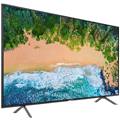
43" Toshiba 43QV3F63DG TV

43" / QLED
Screen Size / Display Technology
4K Ultra HD / 50/60Hz
Resolution / Frequency
Vidaa
Operating System
20W / Onkyo
Sound Output / Brand
100×100
VESA
Key Features of the 43" Toshiba 43QV3F63DG TV
- The screen uses a QLED panel with a 43" (109cm) screen size and 4K Ultra HD resolution
- Access to content is provided by the Vidaa operating system with Netflix, YouTube and Disney+ apps
- The TV supports Dolby Vision picture format and Dolby Atmos sound
- The sound system from Onkyo has a total output of 20W
- Connectivity includes three HDMI 2.0 ports, two USB ports, WiFi and Bluetooth
- The TV is ideal for watching films and streaming content
- Wall mounting corresponds to the VESA 100 × 100 standard

The Toshiba 43QV3F63DG TV uses a 43" QLED panel with 4K Ultra HD resolution to display a detailed picture with a wide colour spectrum. Quantum Dot technology filters light from the Direct LED backlight to create cleaner and more accurate colour shades. The screen supports the high dynamic range format Dolby Vision, which optimises the brightness and contrast for each scene individually. The sound component is provided by a system tuned by specialists from Onkyo, with support for the Dolby Atmos surround sound format. The Vidaa operating system with pre-installed streaming apps such as Netflix, YouTube and Disney+ provides quick access to content. Connectivity is provided by a trio of HDMI 2.0 ports, WiFi and Bluetooth.

QLED and Dolby Vision Picture Technologies
The display is based on a QLED panel with a resolution of 3840 × 2160 pixels and a 43" (109cm) screen size. Direct LED technology ensures an even distribution of brightness across the entire screen area. Support for the Dolby Vision format dynamically adjusts the picture data, resulting in a display with higher contrast and more vivid colours. The TRU Resolution and TRU Flow picture processors take care of picture sharpening and motion smoothness. The panel's refresh rate is 50/60Hz and the brightness is 320 nits, which is sufficient for viewing in normally lit rooms.

Sound by Onkyo in the 43" Toshiba 43QV3F63DG TV
The sound system was designed and tuned by the audio company Onkyo. It consists of two downward-firing speakers with a total output of 20W (2×10W). The TV processes the Dolby Atmos surround sound format, which adds a height component to the soundtrack to create a three-dimensional sound field. For connecting an external soundbar or home cinema system, there is an HDMI port with eARC, which transmits uncompressed audio formats. The user also has a five-band equaliser for detailed sound adjustment.

Vidaa Operating System and Smart Apps
The Toshiba 43QV3F63DG TV runs on the Vidaa operating system, which is designed for fast response and clear controls. The interface offers access to pre-installed global apps like YouTube, NETFLIX, Apple TV, Amazon Prime Video and Disney+. From Czech services, the Oneplay, SledováníTV and LepšíTV apps are available. The equipment also includes support for HbbTV 2.0.2 hybrid broadcasting, which combines TV broadcasting with internet content, for example, to access the archives of TV stations.

Game Mode and Connectivity
Gamers can use the Game picture mode, which optimises the settings to reduce input lag. This makes the response between the controller and the on-screen action faster. With a refresh rate of 50/60Hz, the TV is suitable for casual gaming on consoles connected via HDMI 2.0 ports, which support 4K signal transmission at 60 frames per second. The absence of advanced gaming features like VRR means it is more suited to casual gamers.

Wired and Wireless Connectivity Options
The connector equipment includes three HDMI 2.0 ports (one with eARC) and two USB 2.0 ports for playing multimedia content from external drives or for recording TV broadcasts. The TV connects to the internet via a LAN connector or wirelessly using the integrated WiFi. For wirelessly connecting headphones, a keyboard or a soundbar, there is Bluetooth technology for audio and data transmission. The equipment also includes a digital optical output, a headphone jack and a CI+ slot for paid TV decoding cards.

Design and Mounting
The TV's dimensions with the stand are 965 × 615 × 235mm and without the stand 965 × 561 × 87mm. The weight of the panel itself is 8.5kg, which makes it easy to handle during installation. For wall mounting, it is compatible with the VESA standard with an anchor point spacing of 100 × 100mm. The bezels around the screen are thin and finished in black so as not to be distracting while watching. The package includes a removable central stand, a power cable and a remote control including batteries.

Tuner Equipment and Energy Parameters
The TV has tuners for all types of digital broadcasting: DVB-T2 for terrestrial, DVB-C for cable and DVB-S2 for satellite. HEVC (H.265) codec support ensures compatibility with the current terrestrial broadcasting standard in the Czech Republic. In normal SDR mode, the TV falls into energy class E with a consumption of 42kWh per 1,000 hours of operation. When watching HDR content, the consumption increases to 102kWh per 1,000 hours, which corresponds to energy class G. In standby mode, consumption is below 0.5W.
Specifications
Power outlet type
Energy specifications
Screen size and resolution
Screen
Operating system
Model year
Application
TV functions
Connectivity
Tuners
Dimensions and weight
Colour
Audio
Package contents

Specifications can be changed without notice. Images are for illustrative purposes only.