
Try our cookies Alza.cz a. s., Company identification number 27082440, uses cookies to ensure the functionality of the website and with your consent also to personalisage the content of our website. By clicking on the “I understand“ button, you agree to the use of cookies and the transfer of data regarding the behavior on the website for displaying targeted advertising on social networks and advertising networks on other websites.
Alzak icon
Catalogue
Price
-
Availability
Order status
Brands
(1)

DAC Converters

You can use the digital-to-analog converter (DAC) with computers, modern flat-screen TVs and smartphones. If you just need to connect a TV without an analog output to your favourite hi-fi tower, a cheap converter will do just fine. If, on the other hand, you are looking for a converter for a hi-fi set, studio monitor, or audiophile headphones, get ready to open your wallet.

Continue

DAC Converters Sorted by Usage

  • TV - simple compact DACs, which are usually powered directly by the USB port and can be easily stored anywhere. Don' t expect top-quality sound, this is mainly about getting an analog signal from digital.
  • PC - there are compact D/A converters that you connect directly to USB, as well as larger boxes designed for desktop placement. Almost all PC converters include a high-quality headphone amplifier, so you can also connect audiophile headphones directly.
  • HiFi  - this differs from classic PC converters mainly in that they don't contain a headphone amplifier and in some cases not even a USB port. HiFi components send a digital signal almost exclusively via optical or coaxial outputs.
  • Mobile - extra compact converters with headphone amplifier and powered by a built-in battery. You will use them especially in cases where you have expensive audiophile headphones and using a headphone amp or mobile phone DAC would degrade the sound quality, or it simply wouldn't be enough to reach the required volume (or dynamics).

 D/A Converter (DAC) Digital Inputs

If you buy a relatively budget converter, simply use whatever connector that you have available. For more expensive DACs, you may notice a slight difference depending on the connection. Coaxial and optical have the advantage that they send data in a continuous stream rather than grouped into packets, so they are not affected by jitter.

See below for further connector specifications

  • USB - loss of quality is caused by a synchronous connection method, in which the DAC can't control the data flow. Always choose an asynchronous connection if you can, as it can resolve poor data packet timing (jitter).
  • Coaxial - with an high-end audio set and matching cabling, the sound tends to be more airy and crystalline than when using optical connection.
  • Optical (TosLink) - with a high-end audio set and matching cabling, the sound is softer and less transparent than when connected with a coaxial cable.

 D/A Converter (DAC) Analog Outputs

  • RCA L/R (2× cinch) - a classic pair of analog outputs that transmits a line level signal. You will appreciate it if you want to connect the output to an amp, hi-fi system, or active speakers.
  • 3.5 / 6.3mm jack - used mainly as a headphone output. It differs from the line output in that it also contains a built-in headphone amp, which is used to adjust the volume.
  • XLR/TRS (L/R) - an asymmetrical connection notable for its interference resistance. XLR and TRS connectors are used mainly by professionals (concerts, studios, etc. ) and you will find them on high-quality studio monitors.

You can convert a 3.5mm jack to 2× RCA (cinch) using a simple adapter. It is also possible to convert XLR/TRS to any version of balanced connectors (RCA or jack). 

Sampling and Bit Depth

Generally speaking, the more the better. But if you want to actually hear the difference made by any sampling frequency higher than 44.1 kHz at 16-bit depth, you will need HiFi headphones, HiFi speakers, or studio monitors.

However, if you have your favourite artists downloaded in some high-quality format, such as 192 kHz/24bit, a converter that only supports a lower sampling rate won't be able to decode them at all (output any analog audio). The most used sampling frequencies and bit depths are:

  • 44.1 kHz / 16 bits - classic audio CDs you buy in the store, as well as, for example, MP3 music.
  • 96 kHz / 16 to 24 bits - DVD audio and audio tracks on Blu-ray discs. Widely used by professionals, for example, for mixers, equalizers, and recording devices.
  • 192 kHz / 24 bit - DVD audio and audio tracks on Blu-ray discs. If your decoder can process this sampling, you should be able to play all your music collection in lossless formats, e.g. FLAC, ALAC etc.
  • DSD (higher than 192 kHz) - used for uncompressed DSD 64/128 format (ie 2.8/5.6 MHz), which can be found on SACDs - or its extended variant DSD 256/512 (i.e. DSD 11.2/22.5 MHz) to be precise. Suitable only for true music fans who can get music in these extremely data-intensive formats.

Most external converters have only a stereo output and can only decode a stereo signal in LPCM modulation (the most expensive models can also do it in DSD). So they can't handle Dolby Digital and DTS. If you need to decode surround sound formats, select a unit from the A/V receiver category. 

Hide description
Was this information useful?
This form is used only for evaluating the information in the description above.
If you have any question about our products, services, transport or any other request, please contact our customer support.
What should be improved? Is anything missing here? Is anything wrong? Share it with us.
1 item
4.6 133×
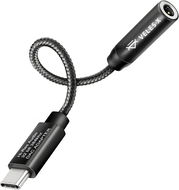
Ugreen Digital To Analog Audio Converter
Splitter (three-way adapter) - female connectors: 1× jack 3.5 mm, 3× cinch (RCA), 1× toslink
Buy with code ALZADNI25 The discount code gives the option of applying a discount on a given product when entering the code in the shopping cart. Získajte zľavu 25% s kódom ALZADNI25. Kliknite a kód sa uplatní automaticky. 11.93 €
15.90 €
Buy
In stock > 10 pcs
Order by midnight, get it at the AlzaBox in the morning.
Info
Order Code: ugre87
AirPodsApple AirPods Max 2 vylepšujú ANC, detegujú konverzáciu a majú lepší zvukový prejav Slúchadlá AirPods Max 2 sú nástupcom populárneho modelu uvedeného na trh už v roku 2020. Keďže sa odvtedy nič zásadné nezmenilo, nová generácia bola nadmieru očakávaná. Má šancu zaujať, alebo sa napokon výrazných zmien a noviniek nedočkáme?
Na prvý pohľad takmer rovnaké, pri počúvaní však prekvapivo presvedčivé. Bose prináša druhú generáciu QuietComfort Ultra – nenápadne, no sebavedomo. Nové farby, drobné vylepšenia a niekoľko funkcií, ktoré dávajú zmysel. Stojí nová generácia za upgrade. Dozviete sa v...
Xiaomi Buds 6 sú kôstkové slúchadlá pre používateľov, ktorí chcú za málo peňazí veľa muziky. Ľahká konštrukcia, pozlátená membrána meniča a zvukový profil ladený v spolupráci s firmou Harman sú len špičkou ľadovca. Nechýbajú ani múdre funkcie, ako je AI potlačenie...
MarshallNové reproduktory a slúchadlá Marshall v limitovanej edícii Midnight Blue Článok predstavuje tri špičkové produkty Marshall, a to reproduktor Emberton III pre bezstarostné počúvanie na cestách, slúchadlá Major V s výdržou cez 100 hodín a domáci reproduktor Acton III so širokým zvukovým poľom. Všetky spája ikonický dizajn, inovácie a dôraz na...
OnePlus Buds 4 síce nesľubujú revolúciu, ale za rovnakú cenu ako vlani prinášajú zlepšenie takmer vo všetkom. Vylepšený zvuk, dlhšia výdrž, adaptívne ANC a pár inteligentných funkcií. Čo presne znamená napríklad funkcia Golden Sound a aký detail im stále bráni k...
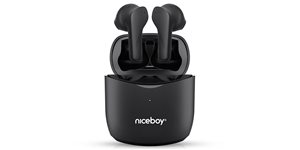
Slúchadlá Niceboy HIVE Beans Concert patria k najlepším True Wireless modelom v portfóliu značky Niceboy. Zaujmú kvalitným zvukom vďaka podpore kodekov aptX a AAC, prívetivou cenou a dlhou výdržou batérie. Ako si počínali v našej recenzii? Poďme sa na to pozrieť!
All articles
P-DC1-WEB11