


Bery Jones Mango slices freeze-dried XXL 250 g

- Reviews 95
- Help and manuals
- Ingredient
- Specifications
- Photos & Videos 4
- Accessories and suggested products

Bery Jones Mango slices freeze-dried XXL 250 g
Freeze-dried mango slices Bery Jones XXL 250 g
The irresistible taste of juicy mango
Enjoy the full flavour of mangoes, even when they're not in season. It is purely natural, contains no added sugar or preservatives and retains a high content of beneficial substances even after drying. Lyophilized mango slices will be especially enjoyed in your favorite breakfast porridge, in yogurt, or just as a snack to munch on.
Main advantages of freeze-dried mango slices 100 g
- Contains vitamins B1, B2, B6 and niacin, but also a variety of minerals
- Every mango must pass a thorough inspection
- Mango slices you can munch on just to taste
- Great in muesli, for example, as a tasty snack to replenish energy
- Resealable packaging

The irresistible taste of mango
Mango is a rich source of vitamins C, E and A, which are among the most powerful antioxidants. It also contains vitamins B1, B2, B6 and niacin, but also a number of minerals such as magnesium, zinc, potassium and iron. It contains a large amount of fibre, which is essential for the proper functioning of the digestive system. Proper manga processing is certainly not a simple process. It has to be processed before it is ripe and fully yellowed, so it is not uncommon to work in three-shift operations during the harvest season. Each mango must undergo a thorough inspection to meet strict quality conditions. Only then can it be processed and prepared for drying. If white spots appear on the dried mango slices, there is nothing to worry about. This is only natural sugaring.

Healthy snacks with mango slices Bery Jones
You can munch on mango slices just to taste, make them into a healthy snack, add them to cereal mixes or take it to an even higher level and make it into a dessert in the true sense of the word. Have you tried coating mango slices in melted chocolate and sprinkling them with coconut?
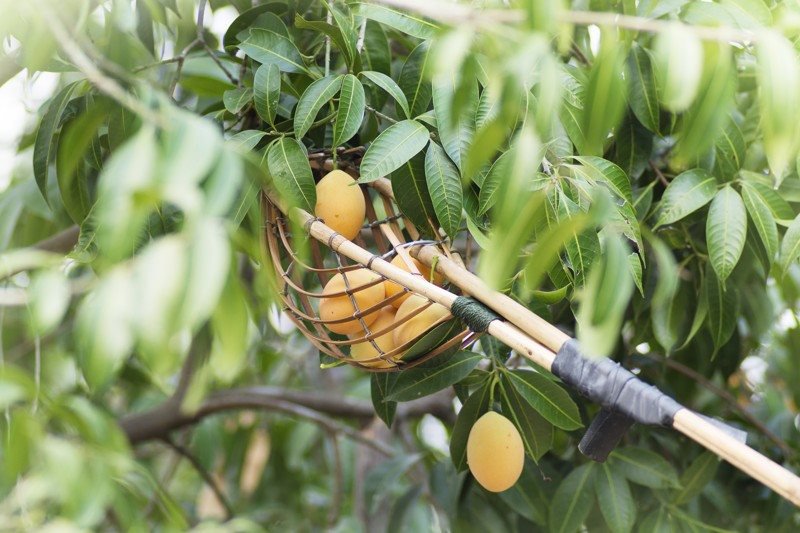
What is freeze-drying?
Before the producer even starts the freeze-drying process, he first selects the best pieces of mango and carefully pre-cleans them. After careful quality control, the first stage of the freeze-drying process is the quick freezing. This takes place at a temperature that corresponds to the exact critical point. This prevents the formation of ice crystals that would break the cell walls of the fruit, thus preserving its nutritional content, texture, flavour, aroma and colour. This is followed by the first slow vacuum drying. This will remove 95% of the water and, if present in the fruit, will also rid it of acetic acid and alcohol. The last stage is the second drying, which is accompanied by a gradual increase in temperature and a decrease in vacuum. The result is crisp pieces of dried fruit that retain the characteristics of fresh fruit.
Nutrition information
Energy value: 310 kcal /1301 kJ, Fats: 2.7 g - of which saturated fatty acids: 0.6 g, Carbohydrates: 67.9 g - of which sugars: 67.3 g, Protein: 3.3 g
Composition and additional information
Freeze-dried mango 100 %Storage conditions
Store dry at temperatures up to 18 °C and relative humidity up to 65 %. Protect from the sun rays.
Specifications
Country of origin
Storage temperature
Fruit
Packaging
Weight
Features
Allergens
Energy value per 100g
Composition per 100g

Specifications can be changed without notice. Images are for illustrative purposes only.